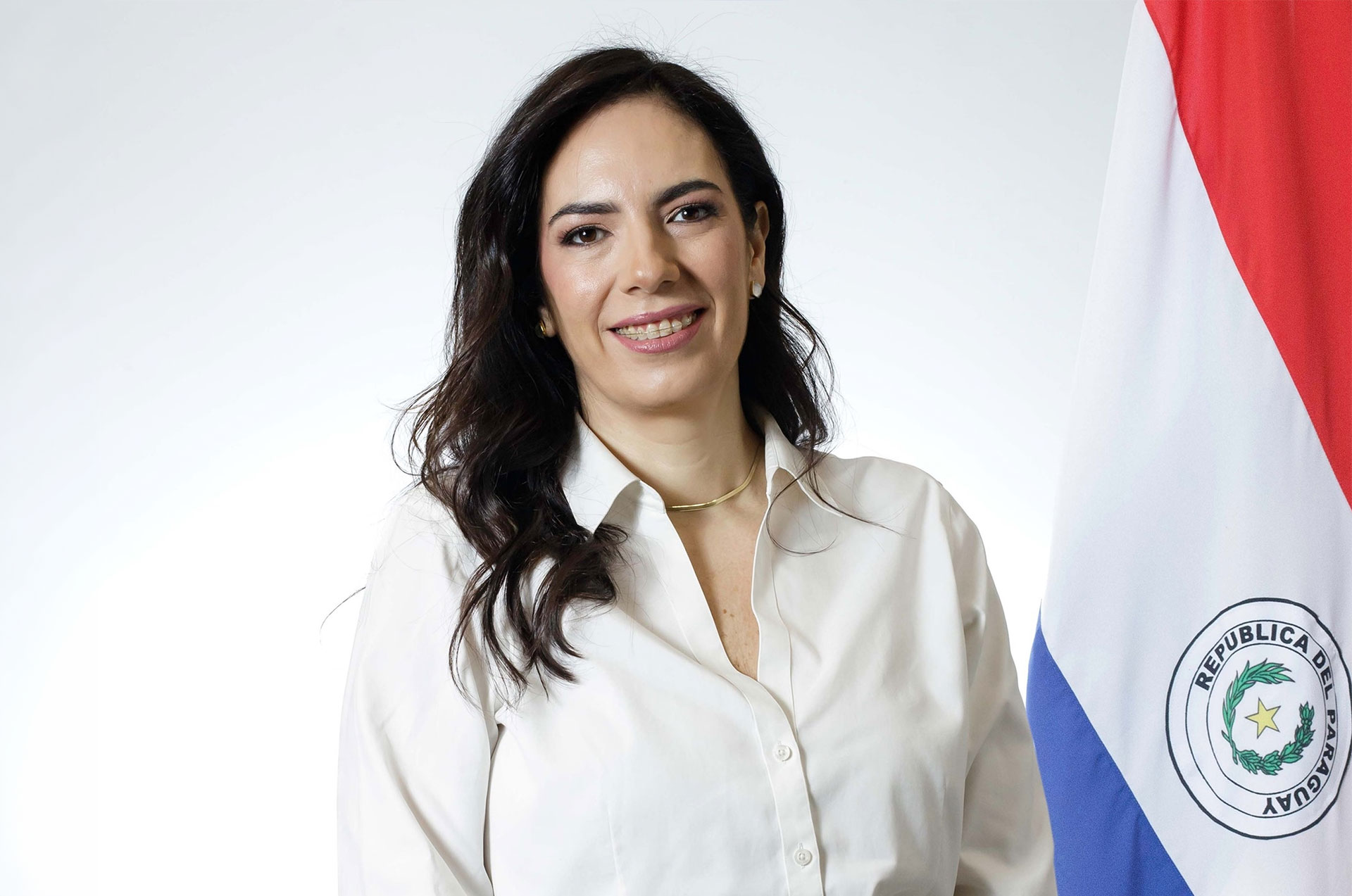

Claudia Centurión, the first woman to lead Paraguay’s Ministry of Public Works and Communications, is driving the country’s efforts to strengthen regional connectivity, develop logistics corridors and expand public infrastructure. Here, she explains how infrastructure investment, renewable energy and public-private partnerships can support Paraguay’s economic development and attract international investors.
Q: What is your vision for Paraguay’s infrastructure development?
The vision we hold at the Ministry of Public Works is to move beyond a purely sectoral approach to infrastructure and towards a systemic one. We are not simply committed to building more kilometres of road – we are committed to ensuring that every kilometre responds to a vision of logistics corridors, and to positioning Paraguay as a major hub in the region. Each project we develop must ultimately generate modal interconnection with our waterway and create genuine competitiveness for the users of that infrastructure, and for the country as a whole.
This ministry is not solely focused on road construction. We face the broader challenge of building the country’s entire public infrastructure. That includes significant programmes in water and sanitation, and what I call social infrastructure – hospitals, schools and early childhood centres. They are part of an integrated vision that addresses the needs of Paraguayans at every stage of life.
The early childhood centres we are constructing reach into neighbourhoods to receive children from birth to the age of four. From there, children transition into schools. We understand that through infrastructure, we also improve education. And of course, where it matters most to Paraguayans is access to healthcare. We are working to strengthen the health system through quality infrastructure that expands medical services and decentralises health provision across the country.
The message I want to reinforce is this: moving from the sectoral to the systemic. None of these projects are ends in themselves – they are a means of enabling the comprehensive development of all Paraguayans.
Q: How will infrastructure help Paraguay seize the EU–Mercosur opportunity?
The EU–Mercosur agreement has placed a serious challenge before us. We must now develop infrastructure that generates competitiveness not only within our domestic market, or with Brazil and Argentina, but externally – enabling our products to reach the end consumer across this vast new trading relationship.
Our approach is centred on multimodal connectivity: linking road to waterway, and developing rail lines to add greater value to products while reducing logistical costs, which is where the real competitive battle is being fought today. A strengthened rural network allows agricultural output to move from the fields to consumption centres, and from there to industries located near our rivers or along routes that genuinely reduce their logistics costs – ultimately facilitating access to nearby ports and onward to international markets.
The key strategic projects are well identified and closely aligned with the country’s industrial development – where maquila industries are establishing themselves, where energy generation and distribution points are located and where we can best serve the ports that are already operational. Rather than making a pure supply-side offer of roads, we are following and anticipating demand.
Q: What investment opportunities does Paraguay offer German and European companies?
Paraguay today offers an extraordinary range of opportunities for investors. We have a fully consolidated and stable macroeconomic environment, a fiscal deficit that is firmly under control, low inflation and a tax system based on the triple-ten structure – 10 per cent income tax, 10 per cent VAT and 10 per cent corporate tax – which is highly attractive for investment. We have clean energy, extraordinarily fertile land, abundant water resources and a young, active population that is highly trainable.
The conditions for investment are in place. We know that beyond consolidating our logistics programme, we will need to invest in energy – because with the growth trajectory we are on, new generation capacity will be required to sustain our industrial ambitions.
We also offer a transparent, solid and robust legal and regulatory framework through which investors can present private initiatives to the state – whether in infrastructure development, energy generation or other sectors. For European companies with the relevant expertise, these are real and immediate opportunities in a country that is also legally stable for purely private investment, beyond the areas directly linked to the state.
Q: How is Paraguay advancing renewable energy and transport innovation?
On the energy side, the first thing we did was present a national energy policy through to 2050 – the overarching framework within which all initiatives must be developed and aligned. Central to this policy has been the enactment of the law on non-conventional, non-hydraulic energy generation, which opens a significant space for new investment. European and German companies with expertise in solar panels, wind energy or other established technologies are welcome to bring those capabilities here and contribute to our future energy mix.
This legal framework is serious and robust. It has been developed with support from the World Bank and international energy experts, and it provides clear guarantees from the state for what are, by nature, long-term investments. It is worth emphasising once more: Paraguay is a country where 100% of the energy is renewable, green and effectively inexhaustible, given that our rivers are a practically infinite source of generation. That is a highly attractive proposition for energy-intensive industries.
On the transport side, we have introduced electric public transport with considerable momentum. A fleet of approximately 100 electric buses – both fast-charging and slow-charging – is now fully operational in the metropolitan area. The ambition is to scale this across the central region, our most important cities and ultimately the rest of the country.
Q: How are public-private partnerships supporting infrastructure growth?
The public-private partnership framework we now have in place has enabled us, for example, to develop the Route 2 PPP project – our main connection between Asunción and Ciudad del Este, linking us to Brazil, our primary strategic market. That project resulted from a law enacted in 2013, which produced its first project in 2017. It is now fully operational. In January of this year, we signed our second project under the Public-Private Partnership Law: Route 1, running south of the capital.
The state’s budget is finite. By selecting commercially attractive projects and deploying our PPP and concessions frameworks to bring in private capital, we free up public resources for infrastructure that cannot be funded by the private sector – health facilities, schools, housing and so on. We are developing an important mix: actively engaging the private sector through PPP and concession legislation, while continuing the social infrastructure programmes that address the most basic needs of Paraguayans.
We recently visited the Bioceanic Corridor bridge – an emblematic project in which Paraguay has invested close to $1 billion. It is being built in a remote locality called Carmelo Peralta. Our commitment as a government is that no Paraguayan is left behind. We have since committed to executing a drinking water plant, a treatment plant, sanitation, public spaces and urban renewal for that community – the first steps towards the urban development that the Bioceanic Corridor will naturally generate.
Q: What does being the first woman to lead the ministry mean to you?
It is, first and foremost, a tremendous honour and responsibility. My message to Paraguayan women is that we do not need to choose between staying at home, raising children and pursuing a professional vocation. If we organise well, we have the space to pursue everything we dream of. But it is teamwork – we cannot do it alone. We are not here to compete with men; we are here to share in building something together.
I also want to draw particular attention to the early childhood centres we are building across the country. They may appear modest in terms of investment, but their human impact is profound. They give families – and particularly women – a safe, nurturing environment for their children during working hours. And in doing so, they give women the real freedom to choose: to work, to contribute, to grow. These are not bricks and mortar – they are a family and childhood policy that strengthens the workforce and advances gender equity simultaneously.
Q: What is your message to German and European investors?
The numbers speak for themselves: Paraguay is the fastest-growing economy in the region. Our achievements in economic stability are clear. Look at the skyline of Asunción and you will see cranes – the country is in full momentum. But beyond growth, Paraguay offers something rarer: a sense of security, of stability, where investors can develop serious long-term projects and also find a quality of life that is genuinely rewarding.
Paraguay is a welcoming, warm country – and that warmth is a defining characteristic of its people. If you can find an environment where serious work is done with joy, with solidarity and with a spirit of partnership, that is a place worth watching closely. And it is a place where every dollar invested will multiply.