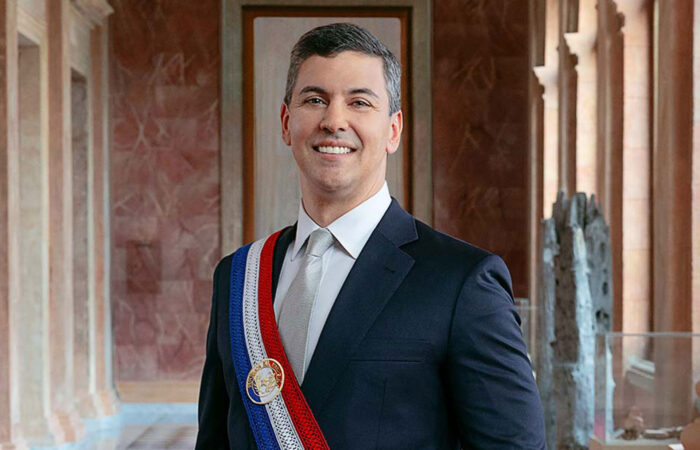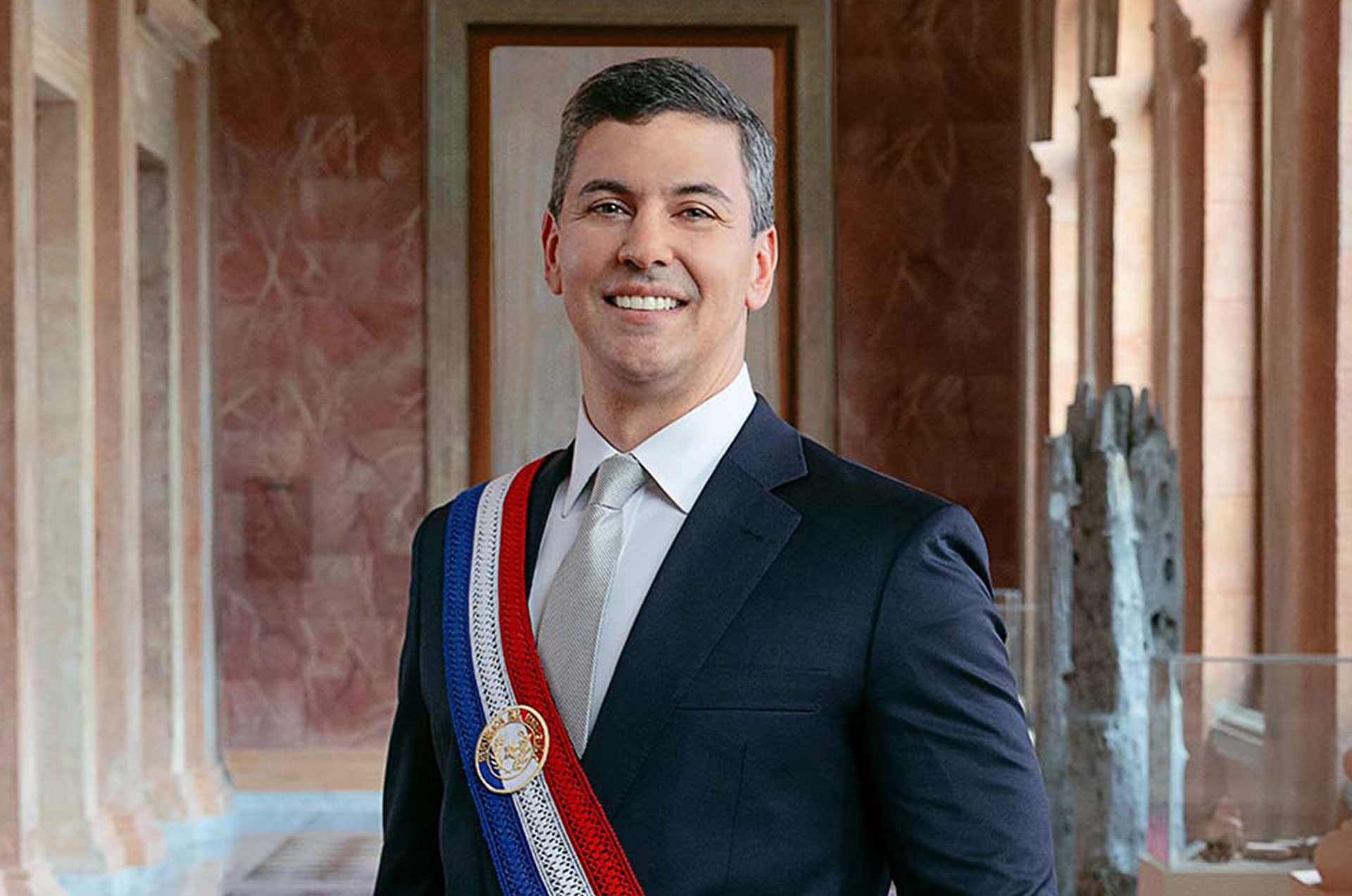

Santiago Peña has led Paraguay since August 2023 with an agenda defined by economic transformation. Built around goals that include doubling GDP within a decade and attaining full OECD membership, his programme prioritises industrialisation, diversification and the development of emerging sectors spanning technology, AI infrastructure and forestry. In this interview, Peña sets out his vision for Paraguay’s resurgence and the opportunity it creates for German partners.
Q: What is your vision for Paraguay in this changing global context?
Paraguay is, in a way, like the world of Pandora. It is a place that has been hidden for many decades, I would say centuries, and now the world is beginning to discover it. Paraguay wants to change the narrative. Now Paraguay needs to make its voice heard.
We are competitive. We understood that it is not the largest or the strongest who survive in competition, but the one who adapts the fastest. That is what we are. We move fast. We adapt faster. The region and the world are beginning to realise that.
Q: How do you assess the relationship between Paraguay and Germany?
What we share with Germany is important. We did not have the massive immigration that other countries had, but we had a more focused type of immigration. One of those waves came after World War I, when Mennonites migrated from Germany and Poland, first to Canada and then to Paraguay.
The Mennonites rely on the cooperative system. After Germany, Paraguay is the country with the largest number of cooperatives in the world. The cooperative system is very important in our production model. That is something we share with Germany: collaboration and joining forces.
German migration here has been relatively small, but very successful. German descendants found the right conditions in Paraguay. In recent years, a new wave of immigrants has come here valuing something very basic but very important to us: freedom.
Q: What is Paraguay’s model for attracting investors?
Our model of success is to provide a safe environment where people can grow, develop and be free, while respecting our culture, laws and regulations. Paraguay has a relatively small government compared with the rest of Latin America. That is why we have maintained low taxes.
Low taxes serve two purposes. First, they create an incentive for the private sector to invest and grow businesses. Second, with a small tax base, you have a relatively small public sector. With a small public sector, the government interferes less in people’s businesses. That gives people more freedom.
This is still to be discovered by Germans and Europeans. Paraguay is full of natural resources, has a small population, a relatively young population and has fulfilled the basic conditions of a country: defence, security, public education and public health. We have grown 1,500% over the last 60 years.
Q: Which sectors will consolidate Paraguay as a partner for European markets?
We have a very strong agricultural base. Soy is the largest crop, and we are the third-largest exporter of soy in the world. We can do three harvests per year. There are not many places in the world where you can do three crops per year because of the weather and geography.
We are also beginning the expansion of a new sector, which is forestry. A tree that takes 25 or 30 years to grow in Europe takes only seven years in Paraguay. That is why there is now a multi-billion-dollar project underway called Paracel, which is a paper mill. Paraguay has 40 million hectares of land, and we have identified a corridor of eight million hectares of high-quality land that is particularly good for forestry.
Agriculture will continue to expand and diversify, not only cattle, soy and rice, but also cotton and forestry. We also see expansion in the industrial sector. Brazil has become the largest foreign direct investor in Paraguay. Many Brazilian companies relocate to Paraguay instead of closing their businesses.
Q: What role will technology play in Paraguay’s next phase?
We are moving rapidly towards becoming the country with the highest GDP per capita in Latin America. At this pace, we could reach Uruguay and Chile in probably a decade. But our aim is not just to have the highest GDP per capita in Latin America. Our aim is to reach OECD standards. We have a country programme with the OECD to become a full member.
To reach OECD income levels, high-income industries are the only way. High-income industries are related to technology. We are working to create an ecosystem for high-technology companies to start and grow in Paraguay. We want to leverage our clean, renewable energy and a labour force that is highly trainable.
Technology is going to be the key. We have partnered with Taiwan and signed an MOU with the government of Taiwan to build an AI data centre in Paraguay. It will be binational. We will combine our energy with Taiwan’s technology and semiconductors to create an entity that, instead of selling energy to Brazil or Argentina, sells computing capacity to hyperscalers and companies like OpenAI.
For us, the advantage is geographic location, no risk of natural disasters, a country in a region with no conflict, political and economic stability and abundant energy. The major constraint for the growth of technology today is energy, and we have the energy.
Q: Can sustainability become one of Paraguay’s competitive advantages?
It can play a big role. Because of our roots, the Guaraní have a deep connection to the environment. They have a strong bond with Mother Nature, and that remains very valid today.
We understand that expanding production should not put our natural resources at risk. We believe we can do both. Because we are latecomers in terms of development, we can understand better than other nations what they did not know a hundred years ago.
One of the laws we pushed at the beginning of our administration was a modern, state-of-the-art carbon credit law, approved in December 2023. We have signed agreements on the implementation of Article 6 of the Paris Agreement with Singapore. We are working on the implementation of the carbon credit market with Singapore, not only to sell credits, but to build the organisational infrastructure to promote the sale of carbon credits and help us protect our own forests.
Q: What legacy do you want to leave for Paraguay?
This is something I think about all the time: what legacy I want to give, and what I think will be a long-lasting benefit for Paraguay. It is about believing in ourselves. Paraguay has no limits. This country is a great nation. It was already a great nation centuries ago, and we are now regaining that place.
As we rise and raise awareness of the things we believe in, Paraguay can become a lighthouse for other countries. I say this with humility. Paraguay can lead by example.
Now we are seeing a younger generation taking over, with a different view, more integrated with the world, more modern and more open. Paraguay has traditionally looked inward, but this is changing.