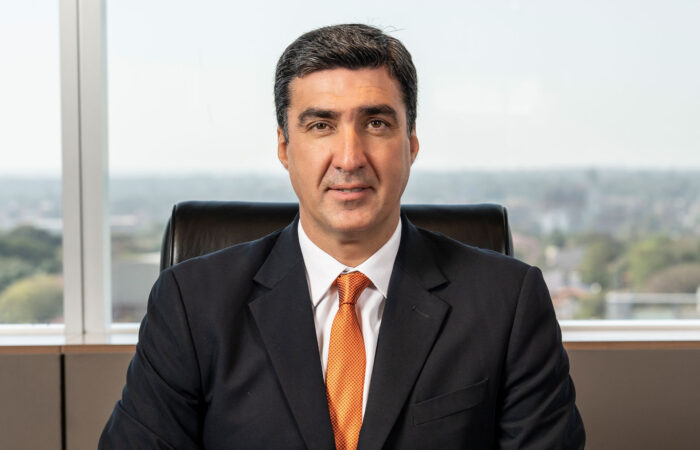

Since taking office in February 2026, Marco Riquelme has been advancing Paraguay’s industrialisation agenda, with a focus on attracting foreign investment, developing higher-value manufacturing and connecting Paraguayan businesses to international markets. Here, he explains the country’s competitive advantages, opportunities for German companies and his vision for Paraguay’s industrial future.
Q: What is your vision for Paraguay’s industrial sector?
At its core, our industrial revolution is a mental shift as much as an economic one. The mentality in Paraguay has often been limited to the domestic market, and while we already have a flow of international investors, we need local investors to understand that global demand exists and that Paraguay can be a major player in meeting it.
The industrial revolution, at its core, is about connecting the global market with Paraguayan capacities, developing industry for the world rather than only for the domestic market.
Q: How do you assess industry’s contribution to Paraguay’s economic growth?
Our strongest foreign direct investment tool today is the maquila regime, under which exporting companies pay a tax of just 1%. This has allowed us to diversify our export matrix and our labour capacities considerably, prioritising job creation over short-term tax revenue.
One of our most striking examples is a prawn company soon to be exporting to the United States and Europe, despite Paraguay having no coastline – proof that we can compete well beyond our traditional commodity sectors. Paraguay is also the only country in the Americas that allows raw materials to be imported from anywhere in the world without tariffs. An Argentine prosthetics company paying a 14% tariff on titanium at home, for instance, can manufacture that same product in Paraguay at zero tariff on titanium sourced from India or China, gaining an immediate competitive advantage.
Our goal is to double the economy to $90 billion within ten years. We will continue to export more meat and soy, but we are equally focused on avoiding the ‘curse of the commodities’, where abundance discourages the development of other industries. South Korea had to reinvent itself precisely because it lacked commodities, and we want to build that same kind of industrial depth, exporting services as well as goods.
Q: What does the Mercosur–EU relationship mean for Paraguay?
The Mercosur–EU relationship will primarily help put Paraguay on the map. At the moment, companies often open a factory in Brazil or Argentina without realising that building in Paraguay could be more efficient and competitive for exporting into those same markets. More than 300 companies have already relocated part of their operations to Paraguay to export back into Brazil, which validates our model.
We have built a structure for policy continuity that matters greatly to investors. I opened an economic council with 25 leading chambers that meets monthly to discuss our industrial policy plan. Because Paraguay has no re-election and a new team can arrive every five years, co-generating policy with the private sector means the next government is expected to continue the plan after 2028. That gives investors confidence that the rules of the game will hold.
Q: What distinguishes Paraguay’s industrial position?
Beyond the tariff-free import regime and the maquila tax rate of 1%, our greatest asset is our people. Seventy per cent of our population is under 40, with an average age of 29, and 100,000 people enter the workforce for the first time every year. Unemployment stands at 3.5%, and ours is a workforce that understands that prosperity comes through sacrifice and discipline rather than subsidy.
Asunción is already the number-one destination for digital nomads in Latin America, and we depend on international investment and migration to accelerate our growth further.
Q: What opportunities would you highlight for German investors?
Paraguay is the only country in Latin America with a German university that grants German degrees. It is a non-profit institution, owned 50% by the industrial chamber and 50% by the German university itself. Students must learn German, spend six months studying in Germany and complete an internship there, which is building the kind of capacity that allows us to attract more complex foreign direct investment and higher-quality jobs.
We want German and other European companies to understand that they can build part of their production chain here. We are not a competitor to Brazil or Argentina; we are part of the production chain for the things we can do more competitively, and building in Paraguay can be more efficient for exporting into the wider region than setting up in a single large neighbouring market. Investors are already responding: last year we had 50,000 residency applicants, a figure that is doubling this year, with Germans among the largest groups after Brazilians and Argentines.
Q: What does the maquila regime mean for employment?
The figure that deserves more attention than any headline export number is the 37,000 jobs generated by the maquila regime. The maquila regime is a deliberate trade-off: we accept the government’s tax sacrifice because it is one of the most powerful job-creation instruments we have.
Q: How is the Ministry building the foundations for industrialisation?
Our industrial revolution rests on three pillars: territorial organisation, financing and capacity building. On territorial organisation, only 40 of Paraguay’s 263 municipalities currently have industrial zoning, so we are pushing mayors to implement it.
This zoning also allows us to build industrial clusters – textile, iron and steel, digital and others – around which we can create targeted training institutions.
Q: What are Paraguay’s main advantages as a regional industrial hub?
Paraguay’s most distinctive advantages converge around energy and regulatory clarity. We have a surplus of baseload electricity – stable, low-cost power that is increasingly scarce globally and is precisely what capital-intensive industries require. Data centres, advanced manufacturing, technology infrastructure: all of these need exactly the kind of reliable, affordable energy that Paraguay can provide, and that advantage sets us apart from most alternatives in the region.
Combined with the maquila regime’s competitive fiscal framework and the broader incentives available through Special Economic Zones (SEZ), Paraguay offers one of the most cost-effective manufacturing environments in South America. Proximity to Brazil and Argentina means those are not only neighbours but substantial consumer markets for what is produced here.
Beyond the financial fundamentals, Paraguay has no significant geopolitical complications – it is a stable country with a government that is actively working alongside the private sector to reduce friction rather than create it. The cultural dimension also matters: Paraguay retains a work ethic and a young, motivated workforce that is genuinely available for employment.
Q: What growth opportunities are now emerging?
The most significant growth opportunity lies in higher-value manufacturing – moving up the production chain beyond primary processing to more sophisticated industrial output. The maquila regime has been a foundation, but the next phase involves attracting advanced manufacturing, electronics, technology infrastructure and, increasingly, AI-related data centre investment that can leverage our energy surplus.
Building the talent base to support that evolution is a parallel priority. The Taiwan–Paraguay Polytechnic University is producing around 100 engineers per year with the explicit objective of reaching the scale at which more complex technology companies will choose to locate here. Certain categories of investors have indicated they require a critical mass of at least 10,000 engineers in-country before committing to full operations. We are building towards that figure systematically – through scholarships, doctoral programmes that require graduates to return after completing studies abroad and the continued expansion of technical education.
Q: What role will AI and data centres play in Paraguay’s industrial future?
Artificial intelligence and data centre infrastructure represent Paraguay’s clearest opportunity in the technology sector. We hold a baseload energy surplus that these facilities demand, and the policy question we are working through is the right equilibrium: sufficient incentive to attract foreign direct investment, while ensuring that what arrives are businesses that develop the country rather than simply extract from it.
The economic council is central to this process. Companies in the data centre and AI space are at the table when we design the policies that govern them. Those already established here have demonstrated the model is viable: they identified the energy advantage, they came and they are growing.
We are moving from a country associated primarily with agriculture and commodity exports to one with a credible claim to being a regional hub for high-value technology and industrial production.