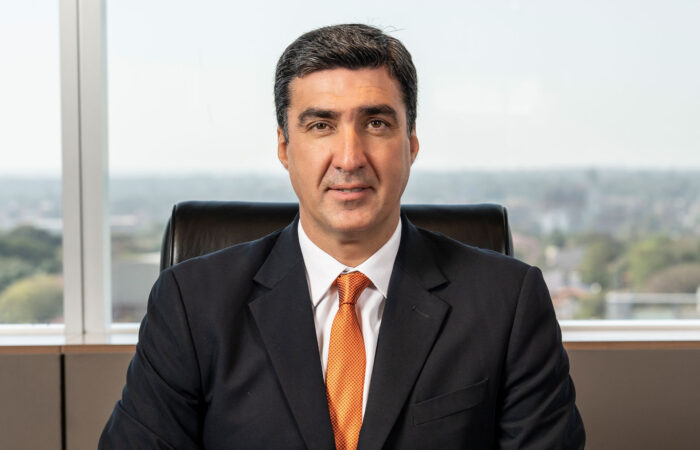

Conor McEnroy, President of Sudameris Bank, sees Paraguay as a market for patient capital, built on deep agricultural roots and clean, amortised hydroelectric energy at $9. Here, he explains how pension fund reform, the National Energy Commission and the EU–Mercosur agreement are setting the stage for growth.
Q: How would you characterise where Paraguay stands today?
We have many things – we are very rich in many attributes – and it is going very well and going very fast.
One thing I say to people who are interested in investing here is this: Paraguay is a place where you must be patient until your particular interest or problem gets onto the agenda. When it gets on the agenda, it will go fast. Paraguay is a place where, when it decides to do something, it will do in three years what it took 30 years to do elsewhere.
Q: How significant is energy as a competitive advantage for Paraguay?
We are spoiled with our hydroelectric amortised energy, which costs $9. Today, the government adds $10 on top of that and charges the local electricity company $19 – and it is still dirt cheap.
I often say that everything in this world comes from three things: land, either what you can grow on top of it or what you can mine underneath it; water, either what falls from the sky or what you have in aquifers underground; and energy. The only one of those three that you can truly manage is energy. Your land is whatever you have. Your water is whatever you have. Your energy is up to you. Our starting point is amortised hydroelectric – clean and $9. We should be the envy of the world.
It is time for us to start managing the resource. That decision has been taken. We now have a National Energy Commission, which is beginning to socialise concepts and bring everyone on board. When you decide to set the basic rules for how things flow, things start flowing very fast.
Q: Where will Paraguay’s next phase of growth come from?
We are an economy quintessentially agricultural in its roots. We sell protein and grain. We have an opportunity to sell cellulose as well. The global market is going through a significant transition.
I see a very bright future for Paraguay in cellulose in particular, because we get to leapfrog. We do our forests better, we manage our carbon impact better, we exploit our cost advantages better. We just need to keep growing those forests, bide our time to put our plants in and take our place on that stage.
This is not unlike what happened with mobile phones. We are in a similar position – arriving late means arriving with better technology and better planning.
Q: What does Paraguay offer patient capital?
Paraguay is a paradise for what I call the Steady Eddie. It is a frustration for the quick buck merchant.
When I offer a product to my customers as a banker, that product is the solution to a problem. My job is not to make loans. My job is to provide financial solutions to a problem. Making a loan is not an end – it is a tool for somebody else to do something.
At some point, you need to get yourself onto a set of train tracks where Steady Eddie does it. And I think that Paraguay is precisely that kind of market.
The analogy I use is a very large crude carrier – a VLCC. If you want to turn one of those four degrees, it might take 28 miles, because it is a big, heavy vessel. You have to go slowly to make it turn. Many institutions have long-term assets that demand exactly this kind of steady hand.
Q: How do you view Paraguay’s lower-tax, smaller-government model?
We took a decision in 2003: small government, small promises, a small tax – but you have to pay it. We could increase our fiscal receipts by 50 per cent if we were more efficient. Our biggest challenge is administrative reform – organising ourselves around how we want to run our society.
Q: Which structural reforms are most critical for financial development?
The pension fund reform is probably one of the most important initiatives of this government. When Chile did it, when Colombia did it, when Peru did it, their economies took off like a rocket. The same will be the case in Paraguay.
I will have the tool to allow businesses to develop. It will enhance consumer demand and, in particular, allow small and medium-sized companies to grow, because they will be able to access financing in their own currency.
The National Energy Commission is equally impactful. Think of it like this: we sat down and decided we are going to drive on one side of the road, not the other. Once you set the ground rules, everything starts moving. Together, the pension fund reform and the energy framework are setting the stage for tremendous growth in Paraguay.
Q: How do you see the banking sector evolving?
We have made tremendous strides. Consolidation is coming, and it is healthy.
What I see going forward is a banking sector that grows significantly alongside the real economy. When you have a business that is growing fast, you have to reinvest your profits. That capital is not surplus – it is fuel.
Q: What is your pitch to German and European investors?
Countries like Germany should pay particular attention to South America. We make food, and we can make primary inputs as we develop our industry – and be a good, reliable, low-cost source of those inputs. What we want flowing back is knowledge, so that we can develop further what we already have.
One of the most exciting recent developments is the German-backed university here in Paraguay. Its founder, Eduardo Felippo, has made a change to Paraguay – probably without even realising how profound the effect of what he has done will be.
The EU–Mercosur agreement is enough to give people pause and prompt a rethink. We make food – good, reliable, clean food.
The pitch is simple: give us market access or give us know-how. We are the ideal trading partner.