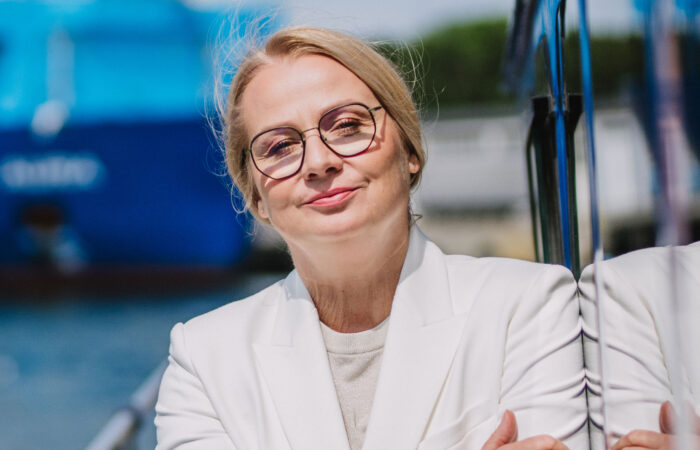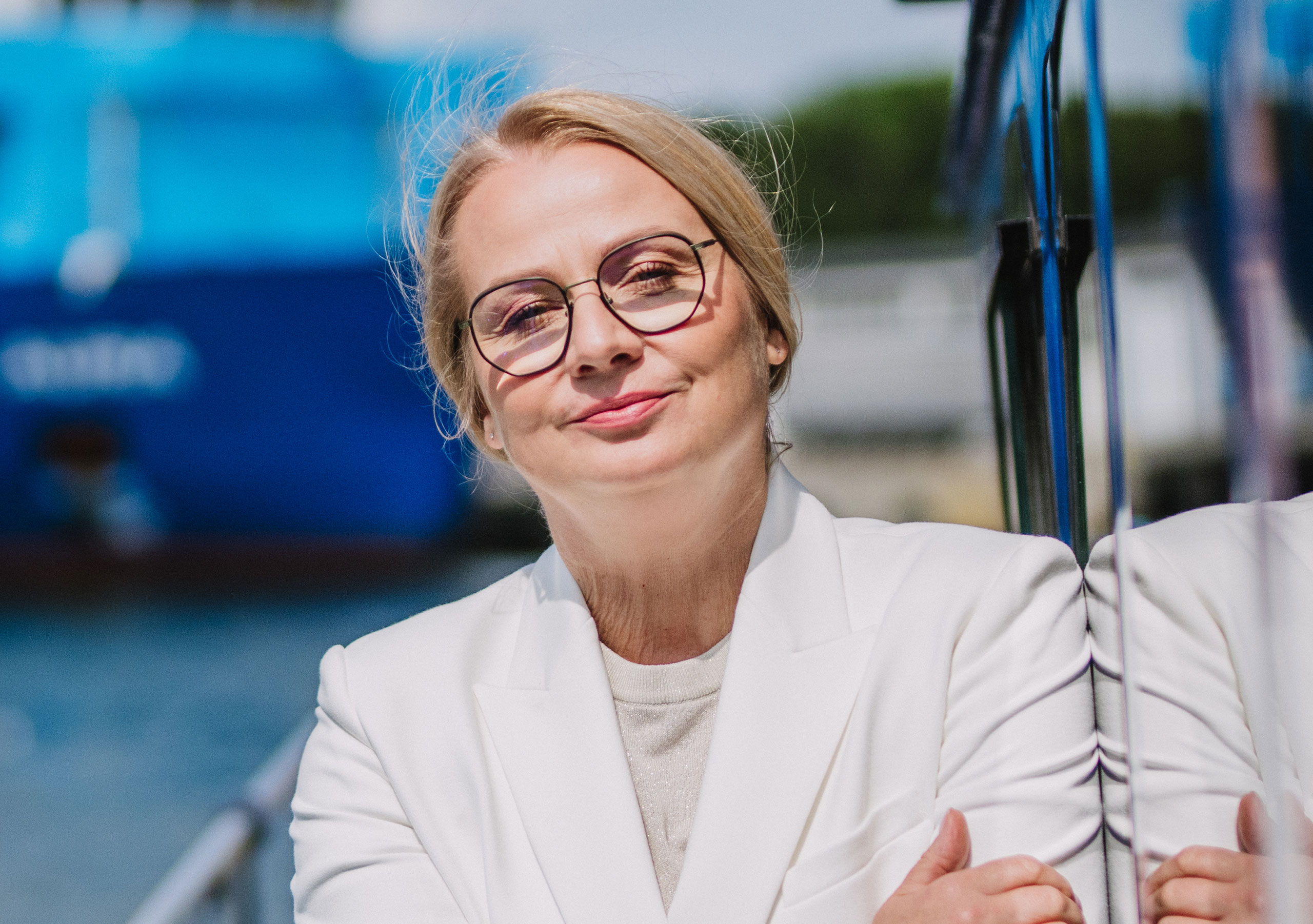

Dorota Pyć, president of the Port of Gdańsk, explains how Poland’s leading seaport is strengthening Baltic logistics, expanding energy infrastructure and serving as a key gateway for European supply chains.
Q: What strategy has shaped your tenure so far?
Since taking the helm, I have anchored the port’s direction around three strategic pillars. The first is infrastructure improvement, with a particular focus on expanding transshipment capacity and strengthening both road and rail connections to our terminals. Rail access is especially critical – it is central to EU transport policy and to our own ambitions to develop intermodal corridors linking the port to domestic and European markets.
The second pillar is process digitalisation. We are implementing modern technological solutions that improve traffic management, cargo handling and communication with business partners, all of which translate directly into greater efficiency and competitiveness.
The third pillar is sustainable development. This is not simply a compliance exercise. I have spent more than thirty years researching sustainability in the Baltic Sea region, and that perspective is embedded in every strategic decision we take. The port consistently invests in solutions that reduce environmental impact, including green energy and technologies supporting the decarbonisation of maritime transport, such as onshore power supply systems, which are now a regulatory obligation under European Union law. Our strategy is also designed to be adaptable to a rapidly changing geopolitical and economic environment – and that flexibility has proven essential.
Q: What have been the key factors behind the port’s growth?
We are the sixth-largest port in the European Union. In 2025, the port handled 80.4 million tonnes of cargo, which moved us up three places in the EU ranking – the largest single-year jump among the continent’s major ports. We are now positioned behind the ports of Rotterdam, Antwerp-Bruges, Hamburg, Algeciras and Haropa, having overtaken the ports of Valencia, Amsterdam and Constanța.
The growth has been driven by strong performance across key segments. Liquid fuels remain the largest category, at 39.6 million tonnes, and general cargo grew significantly, reaching 27.2 million tonnes. Container transshipment itself grew by 23% to nearly 2.8 million TEU, which directly reinforces our role as the primary container hub for the Baltic Sea region.
A significant part of this performance results from the Baltic Hub Container Terminal, and specifically from the launch of Terminal 3 – one of the most technically advanced container terminal facilities currently in operation in Europe. It is equipped with automated secure terminal management systems that increase handling efficiency, reduce processing time and optimise the flow of an intelligent logistics operation. The electrification of terminal equipment and the integration of intelligent technologies also support our emissions reduction commitments. Expanding the Baltic Hub’s capacity to 4.5 million TEU positions us not only for volume growth, but for access to new ocean services and direct global connections.
Sustaining that position requires ongoing investment, not a single landmark project. We are continuously developing infrastructure, modernising the inner port and building the foundations for long-term resilience.
Q: How do you position the port to international partners and investors?
Our competitive case is clear and substantive. The deep-water infrastructure at the Baltic Hub allows us to receive the largest oceangoing vessels directly, without the need for transshipment at Western European ports. For operators, that translates into shorter supply chains, lower costs and greater predictability of delivery. We are also the third-ranked port in the EU for short-sea shipping, which adds a further dimension to our connectivity.
For German investors and logistics operators specifically, we position the Port of Gdańsk as a gateway – a modern, well-connected and continuously developing point of entry to Central and Eastern European markets. The hinterland connections we have built, both rail and road, give international partners direct access to a vast market that is both growing and increasingly strategically important. We offer access to investment areas within the port itself and in its immediate logistics vicinity, including space well suited to distribution centres, warehouses and e-commerce hubs serving the region.
We also emphasise our role in energy security. Through Naftoport, our fuel terminal, the port supplies oil to the refineries in Schwedt and Spergau – providing an alternative supply route for non-Russian crude oil. The construction of a sixth transshipment berth at Naftoport is currently under way, and we are expanding our investment in alternative fuels, LNG logistics, offshore wind infrastructure and decarbonisation technologies. These are not marginal activities; they are central to what the port is becoming.
Q: How important is the port’s role in energy transition?
The ambition to position the Port of Gdańsk as an energy hub is substantial. We have a direction, and that direction is clear.
The energy transition is one of the defining processes of our time across the European Union, and seaports are essential infrastructure for making it happen. We are already investing in onshore power supply systems, which allow vessels at berth to draw electricity from the shore grid rather than running auxiliary engines – a direct reduction in emissions. We are opening up to investments related to alternative fuels, and we are developing infrastructure to support offshore wind operations in the Baltic Sea. The Baltic Sea region has enormous offshore wind potential, and the port is positioned to play a logistical and operational role in that development.
More broadly, the port’s growing role in diversifying energy supply routes – demonstrated by Naftoport’s cooperation with Germany – reflects a wider strategic logic: seaports are not simply commercial assets; they are instruments of national and European energy security. We are building our capacity accordingly.
Q: Where do you see the port in the decade ahead?
Looking ahead, I would like to see the Port of Gdańsk recognised as one of the most important and reliable seaports in the European Union – supportive of others, actively contributing to the strength of the European economy and deeply embedded in the lives of the communities it serves. A seaport is not simply a commercial enterprise. It is a common good.