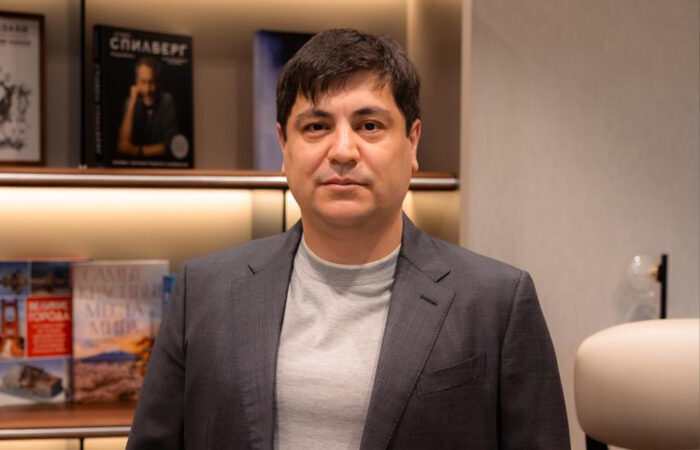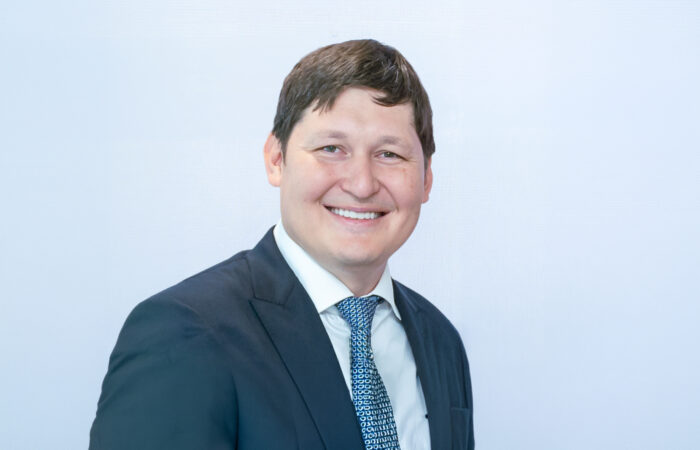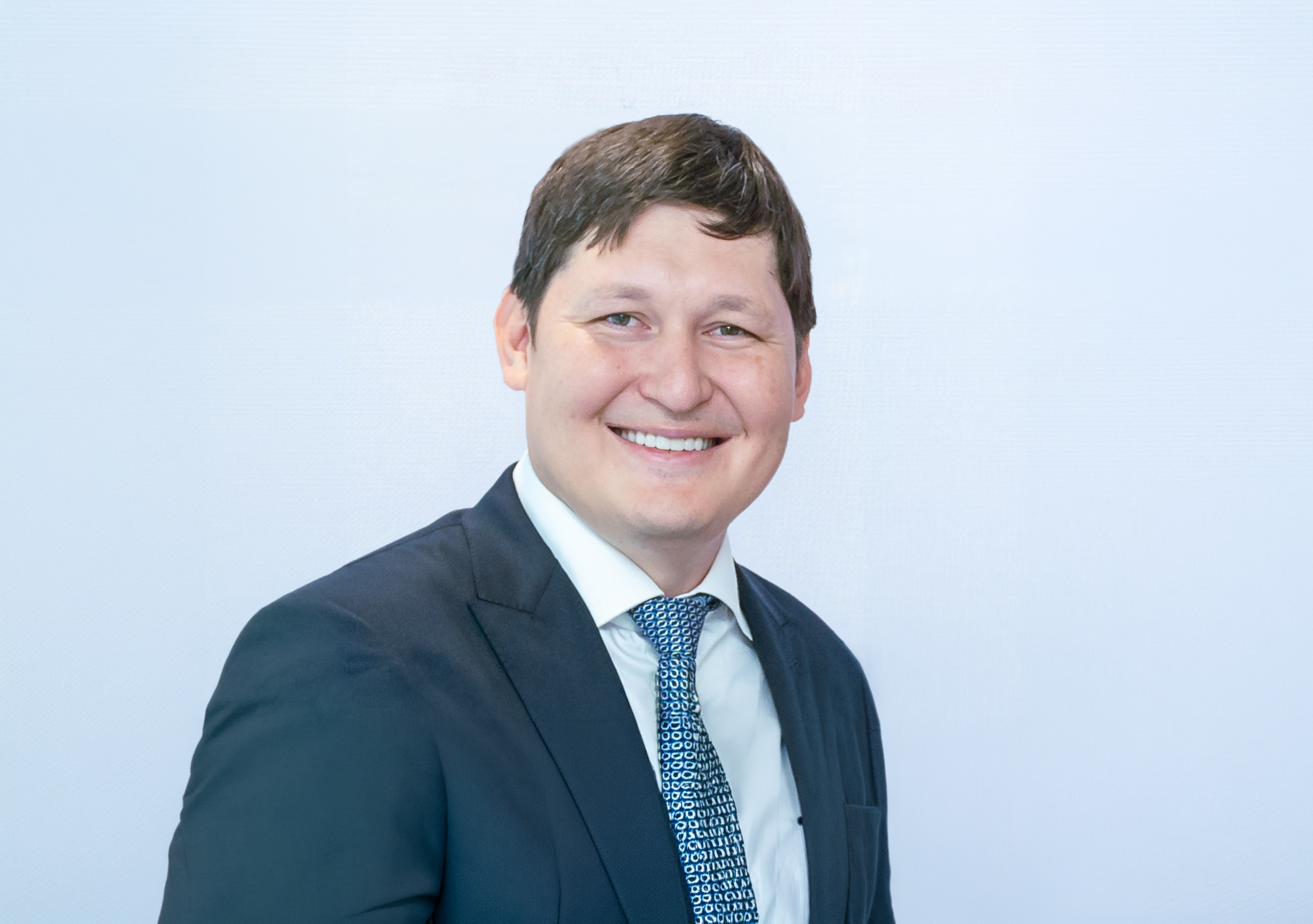

Semurg Invest Group is a private infrastructure holding established to advance projects that diversify Kazakhstan’s economy and support long-term sustainable development. In this interview, General Director Nurzhan Marabayev discusses how the infrastructure group’s integrated logistics platform strengthens Central Asia’s access to global markets.
Q: Can you give an overview of Semurg Invest’s structure and strategic focus, and describe the circumstances of your appointment as General Director?
Nurzhan Marabayev, General Director: Semurg Invest is a private infrastructure development holding that executes projects across several areas of the Kazakhstani economy, most of them in partnership with local or international partners. The group originated in the Mangystau region – the home region of my family and of many of our core team members – and its founding logic was straightforward: to develop private projects within the region that would diversify the local economy, create tangible value for the community and advance measurable sustainable development goals.
That approach has proved strategically well-timed. Projects with strong SDG and ESG content are now very well received by both central government and local administration, which translates into meaningful advantages in terms of government relations. We are seen as a company that is genuinely creating new industries, new employment and new value – and that reputation opens doors.
Over time, the group has expanded beyond Mangystau, though the Caspian coastal corridor around Aktau and Kuryk remains the heartland of our operations. The portfolio has evolved organically: earlier projects in areas such as petroleum logistics, construction, shellstone mining and liquefied gas gave us the capital base and operational competence to move into higher-complexity, higher-value activities. Today the backbone of the group is the Multifunctional Marine Terminal project in the port of Kuryk, which anchors a wider platform that now encompasses shipping, aquaculture, rare and critical metals, and logistics infrastructure.
Q: How did the port of Kuryk and the broader Multifunctional Marine Terminal project originate, and where does it stand today?
NM: The idea for developing an international port on Kazakhstan’s Caspian coast was conceived in 2010, and land was acquired in Kuryk at that time. By 2014 it became clear that a purely private development of strategic port infrastructure – which involves border control, customs, national security assets and multiple state stakeholders – was not viable without a public partner. We therefore signed a cooperation agreement with the national rail and logistics company KTZ to develop the project on a public-private partnership basis, exchanged relevant assets between our two organisations and began joint development in earnest.
The first phases of the port were completed in 2017, and from that point we began investing in private terminals within the broader port complex. Today two of those terminals are being developed in partnership with AD Ports Group (an Abu Dhabi-based ports company). The first – a grain terminal operating under the joint venture Sarzha Grain Terminal – is in active construction and is planned for completion in the first quarter of next year. The second, a much larger multi-purpose terminal comprising container, dry bulk and general cargo handling facilities, reached term sheet and MOU stage last year and is currently in the final phase of joint venture documentation. Notwithstanding some timeline impact from the broader situation in the Middle East, our partners have reassured us that the project remains fully on track.
In terms of overall investment, the multi-purpose terminal represents a total project cost of approximately $150–160 million, of which Semurg Invest has already committed around $56 million. The remaining investment will be drawn from AD Ports Group and from institutional co-investors: we have received letters of interest from EBRD, DFC and the local Industrial Development Fund, and are in active discussions with infrastructure funds in the Middle East. We are targeting financial close within the next four to five months.
Q: How did you secure that relationship with AD Ports Group?
NM: The honest answer is that you have to invest your own money first. A contract, a land title or a feasibility study is not enough. Large sovereign entities, international port operators and institutional investors instinctively gravitate towards state companies – they are perceived as a safe bet, backed by government resources and unlikely to fail. To displace that default preference, a private company has to demonstrate execution: it has to show that the team can close agreements, deploy capital and deliver results.
For us, that meant doing all of the groundwork ourselves before approaching any international partner. By the time we entered conversations with AD Ports Group, the port was operational, our own investment was visible on the ground and we had a functioning terminal. The offer, in effect, was investment-ready. That is a very different proposition from asking a sophisticated counterpart to take a development risk.
Kazakh Invest has also been a meaningful ally in this process. They have representatives embedded in Kazakhstani embassies around the world and perform something close to an investment banking function on behalf of the country – identifying potential partners and facilitating introductions. When a local company is demonstrably delivering results, those introductions carry much greater weight. Kazakh Invest can spend its limited promotion capacity on us because we are not a reputational risk to them.
Q: How does Middle Corridor Shipping fit into the group’s platform, and what drove the decision to enter the shipping sector?
NM: The decision was driven by our clients. Once the first terminal was operational and generating interest from cargo owners, a consistent pattern emerged: clients would commit to using our facilities but then struggle to secure reliable vessel capacity. They could find a vessel but with uncertain pricing, or they could find reliable tonnage but at commercially unattractive rates. Shipping was the missing link in an otherwise integrated platform.
We resolved that gap by creating Middle Corridor Shipping as a joint venture with UAE-based Freeseas Container Shipping. It is, to our knowledge, the first genuinely private international shipping company operating in the Caspian Sea – historically the market was dominated by national carriers, which may have been appropriate when cargo volumes were inconsistent. Now, with the geopolitical shift driving traffic onto the Trans-Caspian International Transport Route, there is a structural case for a private operator tightly integrated with port infrastructure.
We currently own and operate one vessel – the largest in the Caspian Sea – and are planning to expand the fleet to six vessels, adding capacity in step with the progressive commissioning of our terminal facilities. We will take delivery of a second vessel this year. The logic is deliberate: we are not seeking to compete for market share from existing operators. We are focused on serving our own cargo volumes through an integrated terminal-and-shipping proposition.
Q: The group is also developing an aquaculture operation in the Caspian Sea under the Organic Fish brand. How does that fit within a port and logistics holding, and what is the commercial opportunity?
NM:It is a more natural fit than it might initially appear. The project uses the port as its operational base and our shipping company as the fleet manager – so the synergies within the platform are real. Beyond that, it represents exactly the kind of project that demonstrates what Semurg Invest is trying to be: a company that converts local ideas into bankable, internationally relevant businesses.
The project involves breeding Atlantic salmon in the Caspian Sea, which is a unique environment – essentially a large, cold, saltwater lake that partially freezes in winter, making it a viable habitat for premium aquaculture. The technology is Norwegian, the cages and equipment are Norwegian, the feed is Danish-origin and produced in Poland, and the fish stock itself is a cross of Norwegian salmon and Danish trout. It is an international standard of production, made in Kazakhstan.
We are expecting our first harvest in June or July of this year, after which we plan to supply Central Asia and the Middle East with fresh, certified organic, halal-compliant salmon. Aktau has direct flights to Jeddah, Dubai and Medina, which means we can deliver fresh – not frozen – product to Gulf markets on commercially attractive timelines. The product carries both halal certification and best aquaculture practice accreditation, and the slaughter method meets Norwegian animal welfare standards while also satisfying halal requirements. We believe it is a premium product for a premium market.
The project is currently financed with in-house capital and a financial co-investor from the Netherlands. Once the concept is fully validated at scale, we will invite strategic partners – whether for distribution, processing or co-investment in expansion.
Q: How do you see current geopolitical dynamics creating specific opportunities for the region?
NM: Diversification is the operative word. The current situation has made it very clear that dependency on a single corridor – whether the Strait of Hormuz, the CPC terminal on the Black Sea or any other choke point – creates vulnerability that no commercial operator or sovereign government can fully hedge in the short term. You cannot replace the Strait of Hormuz overnight. But you can diversify, and you can ensure that a critical share of your essential imports and exports moves through an alternative route.
The consequence of that realisation is that the Trans-Caspian corridor is no longer simply a trade route of interest – it is becoming a route of necessity for certain categories of goods. Fertilisers are a vivid example at present. A trader who had established a terminal position in Kuryk, secured long-term offtake agreements with Kazakhstani or Uzbek fertiliser producers and built bilateral logistics two or three years ago would today be in an extraordinarily strong commercial position. The same logic applies to aluminium, critical metals and a range of other commodities for which Central Asia is a meaningful producer.
For investors looking at Kazakhstan, the proposition is now quite clear. The country offers well-developed road, rail and electricity infrastructure; a legal framework built around English law through the Astana International Financial Centre; an Investment Committee with binding authority over all government bodies; investment prosecutors under the Prosecutor General’s Office who specifically protect investor rights; a competitive tax environment; and genuinely cheap energy. The one acknowledged constraint is that Kazakhstan is landlocked and distant from international consumer markets – but that is precisely what efficient containerised logistics through Kuryk is designed to address. Once we connect our port to the global container shipping network, that constraint is largely resolved. That connection is what we expect to complete this year.
Q: What message would you like to convey to international investors – particularly from the Gulf region – who may be considering Kazakhstan and the Caspian for the first time?
NM: The message is simple: the time to establish a position is before demand becomes urgent, not after. The investors who are most effectively navigating the current volatility in global supply chains are those who built their diversification strategies three or four years ago. The conversation we are having today in Kazakhstan – about logistics, critical metals, food security, containerisation – is the conversation that should have been happening in the Gulf five years ago.
What Semurg Invest offers is a local partner that has done the groundwork: the infrastructure is partially built, the institutional relationships are in place, international partners of the calibre of Abu Dhabi Ports Group are already engaged and the legal and financial frameworks to protect foreign capital are robust. We are not asking investors to take a development risk on an idea. We are offering co-investment in operational or near-operational assets within a platform that has demonstrated its capacity to execute.
For a Gulf investor interested in critical metals, we have an exploration and production company and a logistics operation to move that material to market. For an investor interested in food security and the premium food trade, we have an aquaculture operation ready to supply the region with certified organic salmon. For an investor interested in port infrastructure and the trans-Caspian corridor, two of the four terminals in our multi-purpose complex are still available for partnership. The range of entry points is wide – and in each case, we can serve as a catalyser, connecting investors to the broader ecosystem of projects and partners across the region.