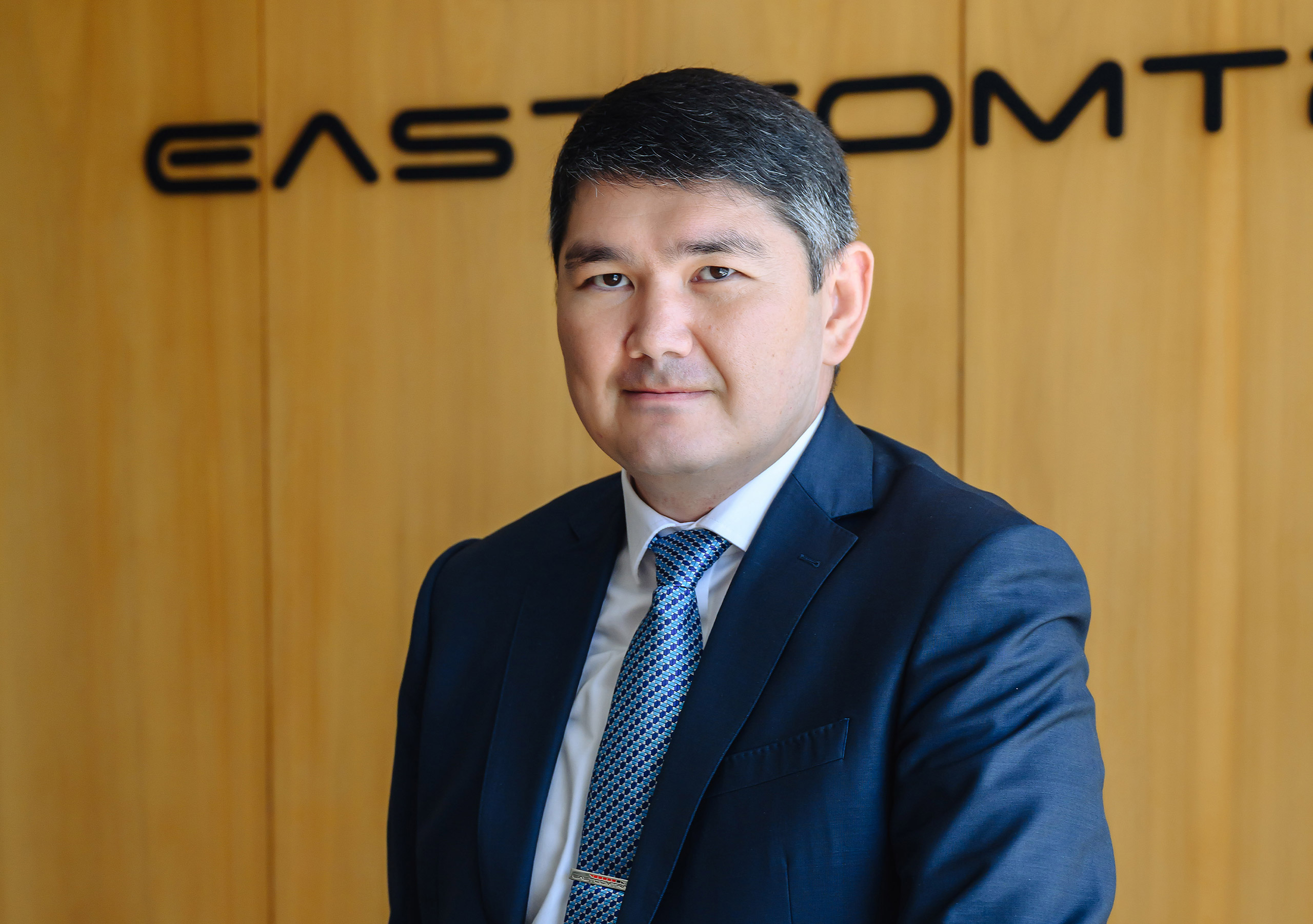

As Kazakhstan’s largest privately owned logistics operator, Eastcomtrans is a central player in the country’s growing role as a trade and logistics hub. Here, CEO Almas Abaideldinov discusses how the company delivers tailored transport solutions backed by data analytics and operational expertise.
Q: How would you describe Eastcomtrans’s strategic priorities and 10-year development plan?
Almas Abaideldinov, CEO: I joined Eastcomtrans in 2021, and this year marks five years with the company. After my appointment as CEO, we engaged leading international consultants with two objectives: to develop a 10-year strategy and to improve execution through internal optimisation, identification of weak points and a roadmap to address them.
We worked with McKinsey for about six months to review internal processes, client and partner interactions, and wagon-fleet operations. They identified significant opportunities to improve operational performance and outlined seven major initiatives, each supported by five to seven actions. These covered organisational structure, business processes, client workflow and documentation, digital transformation, and maintenance. We assigned accountable leaders to each initiative, implemented an action plan and continue to execute the programme. Some initiatives delivered major improvements in operational effectiveness.
We also worked with PwC to develop our 10-year development programme through 2032. PwC assessed the market, our company and our needs, and we jointly created a strategic roadmap. Three years after completion, we continue to operate in line with that plan.
A key target was to expand our fleet from 10,000 wagons to 15,000 by 2027. Market conditions shifted materially after 2022 due to geopolitical factors, so we have postponed the timeline but not the strategy. In 2021 we had 10,000 wagons; this year we have 12,500, meaning we added 2,500 wagons in three years. We expect to reach 15,000 later than 2027.
We expect 2026 to be challenging. When asked about Kazakhstan’s economy in 2026–2027, I often say it depends on U.S.–China relations and China’s economic trajectory.
To reduce exposure to volatility, we made fleet diversification a strategic priority. Within our 12,500 wagons, we operate multiple wagon types, including gondola cars, boxcars, gas tank cars, oil tank cars, isothermal wagons and specialised wagons for sulfuric acid, as well as platforms. We also operate two to three container types. We have also diversified geographically across the former CIS, with offices in Russia, Uzbekistan and Kyrgyzstan; multiple branches in Kazakhstan; and an office and joint venture in China. We are also planning additional joint ventures with Chinese companies. We are currently evaluating where to expand next and may announce new countries this year.
Q: Can you share the direction of your geographic expansion, such as regional focus and new offices?
AA: We are evaluating multiple opportunities, including Turkmenistan and Tajikistan. Tajikistan may supply various raw materials. Turkmenistan is relatively closed, but if sanctions on Iran ease, a key rail route to Iran would run through Turkmenistan. The Iranian market is large, and Iran can also provide a corridor to Pakistan and other high-population markets. In that scenario, Kazakhstan’s role as a transit country would increase significantly.
Q: Can you share the direction of your geographic expansion, such as regional focus and new offices?
AA: We are evaluating multiple opportunities, including Turkmenistan and Tajikistan. Tajikistan may supply various raw materials. Turkmenistan is relatively closed, but if sanctions on Iran ease, a key rail route to Iran would run through Turkmenistan. The Iranian market is large, and Iran can also provide a corridor to Pakistan and other high-population markets. In that scenario, Kazakhstan’s role as a transit country would increase significantly.
Q: What is your outlook for Kazakhstan’s market and sector maturity, and what would help private operators like Eastcomtrans operate more effectively?
AA: In 2025, overall cargo turnover increased, and GDP rose from about 6% to 6.5% as stated officially. Cargo transportation continues to grow, and several major industrial projects are underway, including in Atyrau (western Kazakhstan) and central Kazakhstan. These are not only raw-material projects; they also include higher value-added production. When these projects come online, cargo volumes should increase significantly.
Rail infrastructure is managed by the national operator KTZ. In 2025, KTZ completed two important projects supporting transit and international trade. The Dostyk–Moyinty project strengthens capacity from the China border area to Moyinty, and further development continues toward Kyzylzhar. KTZ also completed the Zhetygen–Kazybek Bek line near Almaty, a roughly 90-kilometre bypass that reduces congestion by routing trains around Almaty rather than through the city. This improves flows from the Chinese border toward Uzbekistan, Turkmenistan and southern Kazakhstan.
The government initiated additional rail projects two to three years ago, with some expected to complete this year and others next year. Beyond physical infrastructure, KTZ is also advancing digital solutions. In some cases, the quality is comparable to or higher than Europe. For example, we receive hourly location updates for every wagon, and there is potential to increase update frequency to every 30 minutes. We provide clients with visibility on wagon location, status, estimated arrival, speeds and operational stage, plus forecasting.
Q: Is this digital capability provided by KTZ, or is it your own platform rollout?
AA: KTZ provides the base data, and we add value by delivering additional analytics and digital support to clients. Internally, we also develop our own digital capability. We use a complex mathematical algorithm to assign wagons to stations and optimise movements. Due to tariff differences by cargo type, empty return tariffs can differ even for identical wagons returning to the same destination, depending on what was previously carried. Optimising this across a fleet of about 12,000 wagons, including wagons under operation and those leased out, creates roughly 300,000 to 400,000 routing and allocation options per month.
Our objective is to return wagons to clients quickly, deliver on time and maximise value. Higher value and faster turnaround allow us to offer more competitive pricing while improving our profitability. This software is for internal use.
Q: Beyond client relationships and digital solutions, what are Eastcomtrans’s key competitive advantages as Kazakhstan’s largest privately owned operator?
AA: We serve a diverse client base, including long-term clients who have worked with us for 10–20 years, and we onboard new clients each year. Our key advantage is providing end-to-end solutions rather than only capacity. Because we operate diversified wagon types and specialised teams, we can design complex transport solutions, including multimodal routes, for clients who do not have sufficient information to plan them.
For example, for a shipment from Malaysia to Tashkent, we can evaluate routes via sea, via Pakistan through Karachi or via China, using a multimodal combination of containers, wagons and road transport across multiple borders. For domestic flows, when a client provides origin, destination and expected monthly volume across a year, we recommend the optimal route and execution plan to reduce time and cost, and we flag practical risks and constraints with alternative approaches.
When we quote pricing, we also embed our operational knowledge and preventive problem-solving. One long-term client assessed the difference between using market rates or standard tariffs versus our service and identified savings of up to 45%. We do not sell consulting separately; our value is delivered through the transportation solution itself, combining reliability, speed and cost reduction.
Q: Beyond transport logistics and fleet investment, what other investments is the company making under the 10-year plan?
AA: Under the 2022 strategy, we are diversifying beyond the wagon fleet and beyond transportation activities. A separate team, overseen by our shareholder, evaluates industrial opportunities in Kazakhstan. In 2025, they assessed seven to eight projects aligned with our shareholder policy and strategic development agenda.
We are reviewing infrastructure opportunities tied to client sites. We plan to support clients by developing rail infrastructure, including constructing dedicated rail links to client facilities. This is not our core business, but we have the experience and partners to deliver it, and it supports long-term client relationships by making operations easier for them.
Q: Regarding international cooperation and the Gulf and wider Middle East, where do you see practical partnership opportunities?
AA: Our business is primarily tied to Kazakhstan-linked cargo. We have fewer transit operations because transit is largely managed by state-owned companies, and our newer fleet is prioritised for international trade flows, primarily with China and Russia.
When cargo comes from other countries, it typically moves through seaports. The largest ports we use are in China and Russia, including ports on Russia’s Baltic and Black Sea routes. Black Sea routes face pressure due to the regional situation involving Ukraine. Routes through Georgian ports are more complex and less developed, requiring coordination across multiple countries and still-developing rail infrastructure compared with Russia.
Since the conflict began, routes through Azerbaijan and Georgia became congested. The situation has eased, and the route through Poti, often referred to as the Middle Corridor, has grown significantly. However, it requires substantial investment, intergovernmental negotiations and aligned positions. Because of these complexities, Middle Corridor development is primarily led by KTZ.
For international investors, the most visible opportunities include infrastructure, fleet renewal and digital solutions. We operate a major logistics terminal near Almaty dedicated to export-import operations, and we are also developing transit capabilities through that terminal. Digital solutions, including artificial intelligence and interoperable platforms that connect seaports, logistics terminals, railways and manufacturers across regions, could create durable competitive advantages in Kazakhstan and across the CIS.
Q: What opportunities do you see for strategic investors, and what investment opportunities are most relevant?
AA: We have several projects under detailed analysis and prepared for final shareholder decisions. More broadly, Kazakhstan has many opportunities beyond raw materials, including industrial projects, and this remains a favourable time to invest.
Q: Why Kazakhstan, and why now? Which sectors remain attractive?
AA: Kazakhstan plays a significant role in transit. In 2025, transit traffic along the Middle Corridor increased by 12%, highlighting its importance for China–Europe flows, and volumes through Russia have also increased. Given Kazakhstan’s location between major producing and consuming regions, China and Europe, with part of Kazakhstan located in Europe, along with proximity to the Middle East and high-population southern markets, it can be more efficient to produce goods in Kazakhstan and reduce transportation costs for export to major consumer regions.
Q: As closing remarks, what is your outlook for 2026 and your key priorities for the year?
AA: Kazakhstan remains highly exposed to geopolitical developments. As a major raw-material supplier, Kazakhstan’s outlook depends on how these dynamics evolve.
We expect several major projects to begin or enter operation. If conditions remain broadly stable as in 2025, with limited volatility, the economy may continue growing. However, recent events illustrate the risks: drone attacks on Caspian Pipeline Consortium infrastructure in the Black Sea and production upsets at the Tengiz field disrupted the export and production of Kazakhstani crude, prompting Tengizchevroil to significantly reduce oil output in late 2025 and early 2026. Around 80% of the crude exported to European countries via the CPC originates from Tengiz, Kazakhstan’s largest oil field. Tengizchevroil is a major oil producer, taxpayer and employer, so disruptions there can materially affect Kazakhstan’s overall economy.