CAIER’s work on ESG, biodiversity and regional water management is supported by independent data and applied science
Founded in 2012 and headquartered in Almaty, Kazakhstan, the Central Asian Institute of Ecological and Environmental Research (CAIER) emerged at a time when environmental issues in the country were largely treated as secondary considerations. Over the last decade, the institute has developed from a single room with limited equipment into a fully equipped research organisation working across industrial waste management, biodiversity protection, water resource management and ESG consulting.
“Over 13 years, CAIER has grown from a small scientific organisation into one of Kazakhstan’s leading independent environmental research institutes, and, I believe, one of the strongest in Central Asia,” says Aselle Tasmagambetova, founder of CAIER.
CAIER’s positioning rests heavily on independence and scientific credibility. Unlike many research bodies operating in resource-rich economies, it has deliberately avoided financial dependence on oil and gas producers. This independence, particularly for large-scale fieldwork such as annual expeditions to the Caspian Sea, underpins the institute’s role as a neutral data provider.

“Our strength lies in combining fundamental science with applied science. We are not simply an academic institution producing reports; we develop practical solutions that industries can implement, scale and monetise,” says the founder.
That applied focus has shaped CAIER’s commercial model. Its patented technologies include methods for converting oil-contaminated soil into construction materials and advanced industrial wastewater treatment systems. These solutions have been commercialised with companies operating in Kazakhstan’s extractive sectors, allowing the firm to fund its research while maintaining institutional autonomy.
Environmental monitoring has also become a core activity. CAIER now works with oil, mining and financial sector firms on independent assessments, ESG frameworks and sustainability reporting. In 2023, the institute became one of the first organisations in the region to join the UN Global Compact Network, reflecting growing alignment between local practice and international sustainability standards.
“Kazakhstan is currently one of the most active countries in Central Asia in implementing ESG principles,” says Tasmagambetova. “I am proud that we have advised several banks that have since achieved top S&P ESG ratings.”
Beyond ESG consulting, CAIER’s scientific work has drawn sustained attention to biodiversity loss, particularly in the Caspian Sea. Since 2014, the institute has documented the sharp decline in the local seal population, an indicator species for the health of the wider ecosystem. Its research has contributed to the inclusion of the Caspian Sea in Kazakhstan’s Red Data Book. “If the Caspian seal population is healthy, the Caspian Sea is healthy,” Tasmagambetova says.

Water security, in particular, has emerged as CAIER’s most urgent priority. In 2025, the institute launched the Central Asian Advisory Board on Environmental and Sustainable Development, bringing together experts from Kazakhstan, Uzbekistan, Kyrgyzstan, Turkmenistan and Tajikistan. The board’s first major initiative is the development of a regional Water Master Plan, responding to shared dependence on transboundary rivers and accelerating climate pressures.
The institution’s approach emphasises coordinated regional planning supported by scientific data, with CAIER also seeking international partners and financial institutions to co-fund research and implementation. In the past years, the organisation has collaborated with several players, including with Mekorot on Almaty’s Water Master Plan, as well as universities and research centres in the United States, Europe and the Middle East.
“We see many areas of synergy with UAE based companies and investors who have achieved impressive results in desalination, clean energy and circular-economy projects,” Tasmagambetova says.
Kazakhstan’s economic diversification, regulatory support for green finance and growing talent base has created opportunities for Gulf investors in areas such as water reuse, waste management, clean manufacturing and sustainable infrastructure. “Kazakhstan is now experiencing steady economic growth and entering a new phase of green industrial transformation,” she adds.
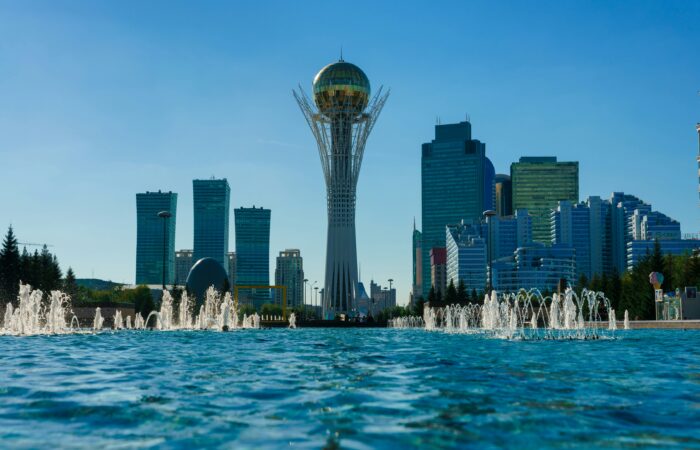
Tasmagambetova also highlights the Astana International Financial Centre (AIFC) as a strong platform for international investors, offering a distinct legal framework and governance model aimed at transparency and investor protection. “This is an aspect of Kazakhstan that is not widely known internationally, yet it is a major strength,” she notes.
While CAIER’s work spans science, consulting and policy engagement, at the heart of its philosophy is the belief that sustainability as fundamentally human rather than technical. Through parallel initiatives in philanthropy, education and manufacturing, she has pursued what she describes as long-term impact rather than short-term visibility.
Although landlocked, Kazakhstan’s transport strategy extends beyond road and rail corridors. Routes through the Caspian Sea and onward via the Caucasus, Iran and the Persian Gulf are also being developed, with separate policy frameworks for each. The stated objective is to position the country as a logistics hub, rather than just a transit state.