Officials outline reforms and infrastructure plans aimed at attracting $150bn in foreign investment by 2029.
As competition for capital intensifies globally, Kazakhstan is refining how it presents itself to international investors, placing greater emphasis on efficiency, sector focus and regional connectivity. In an exclusive interview, Sultangali Kinzhakulov, Chairman of the Management Board of Kazakh Invest, outlines how the country is recalibrating its investment strategy.
“In the Central Asian and Eurasian regions, Kazakhstan stands at the centre of investment attractiveness. Our main target is to attract $150 billion in investments by 2029,” he says.
According to Kinzhakulov, global investment flows have become more selective in recent years, shaped by geopolitical uncertainty, supply-chain reconfiguration and rising capital costs. This environment has forced investment agencies to rethink both how and where they compete. Kazakhstan’s response has been to narrow its priorities while addressing long-standing procedural barriers that investors have flagged as friction points.
Such a target, set at government level, has driven a reverse engineered strategy that works backwards from 2029 to near-term reforms. Kazakh Invest has consulted international advisory firms to assess legislative bottlenecks and administrative delays, with the aim of shortening investment timelines and improving predictability.
Alongside this, the agency has commissioned sector-specific studies, including oil and gas equipment manufacturing, to provide prospective investors with clearer commercial data before market entry. A central pillar of the revised strategy is the development of special and industrial economic zones.
Kazakhstan currently operates 17 special economic zones. Drawing on Kinzhakulov’s prior experience working with Chinese investors, the agency is now seeking to consolidate rather than expand, selecting a limited number of zones to pilot international best practices.
“These zones will align with the Middle Corridor, forming part of the supply and infrastructure chain along major transport routes,” he says.
Two initial pilot zones are planned, one near China and one closer to Europe, reflecting Kazakhstan’s role as a transit economy between the two markets. Trade between China and Europe totals an estimated $750–800 billion annually, much of it moving overland through Kazakhstan. The government’s ambition is to capture more value from this transit role.
Although landlocked, Kazakhstan’s transport strategy extends beyond road and rail corridors. Routes through the Caspian Sea and onward via the Caucasus, Iran and the Persian Gulf are also being developed, with separate policy frameworks for each. The stated objective is to position the country as a logistics hub, rather than just a transit state.
Investment data suggests that Kazakhstan remains the dominant destination for capital in Central Asia. In 2024, foreign direct investment reached $17 billion, bringing cumulative inflows since independence to approximately $470 billion. Kazakhstan also generates around 55% of Central Asia’s total GDP, and 60% of all FDI in the region is directed to Kazakhstan.
“This reflects Kazakhstan’s leading regional position and investment capacity,” Kinzhakulov says.
International ratings agencies have responded accordingly. In 2024, Moody’s assigned Kazakhstan a Baa1 sovereign rating with a stable outlook, citing diversification away from hydrocarbons and growth in services, transport, logistics and IT. The country has also climbed global competitiveness rankings, which Kazakh Invest views as both validation and leverage in investor outreach.
Institutionally, the agency is attempting to move beyond deal-by-deal facilitation. A core element of this shift is the National Digital Investment Platform, which integrates licensing, permitting and monitoring tools across government bodies. The system allows projects to be tracked in real time.
“We actively use digital solutions and plan to introduce AI to the platform soon,” Kinzhakulov says.
This digitalisation underpins a broader lifecycle approach. Kazakh Invest now distinguishes between industrial targeting, active project sourcing with regional authorities and post-investment monitoring. The latter, Kinzhakulov argues, is essential for encouraging reinvestment by existing investors, which he describes as easier and more cost-effective than attracting new entrants.
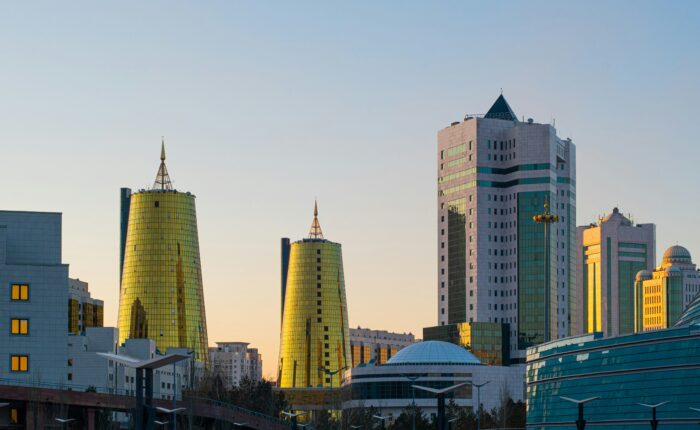
The agency has identified several priority sectors. Renewable energy, for instance, is a priority for Gulf partners. The UAE-based developer Masdar is developing a 1 GW wind farm in Kazakhstan, a project valued at $1.4 billion and expected to be completed by 2028. “Mutual investments from Emirati companies have exceeded $5 billion. We have already signed 20 agreements across various sectors, including energy, infrastructure, manufacturing, the agro-industrial complex and finance,” Kinzhakulov says.
Agriculture is another focus, particularly in organic and halal production. “Kazakhstan has approximately 220 million hectares of agricultural land, representing enormous, untapped potential,” Kinzhakulov notes.
The tech sector is a parallel priority, mainly focused on US and China-based companies. Global technology firms including Microsoft, Amazon, Meta and TikTok have established regional operations in Kazakhstan, while Telegram is developing an AI laboratory in Astana. The capital is also home to Astana Hub, a hub that hosts more than 1,200 technology companies across fintech, AI and software development.